


On Good Authority
7 October 2026
Hi there,
Welcome to this edition of On Good Authority which includes oceans, open data tools and overseas news. The UN General Assembly has made its first declaration on sea-level rise and there’s new research linking individual project emissions to climate impacts now available. Our news in brief items also include an update on the state of our pole ice.
In breaking news as we were finalising this edition, the High Court of Australia has upheld a NSW Court of Appeal ruling that invalidated approval of a coal mine expansion at Mount Pleasant in New South Wales. The decision has implications for legislative schemes that require consideration of greenhouse gas emissions.
For further news and updates please follow us on Facebook, Instagram and LinkedIn.
Authority news
Our Chair, the Hon. Matt Kean, delivered a keynote at the Asia Pacific Circular Economy Hotspot in Sydney on the role of the circular economy in reducing emissions and supporting Australia’s transition to net zero. In an article in The Guardian, that responded to NSW approval to expand a Hunter Valley coal mine, our Chair also warned that the climate crisis ‘isn’t someone else’s problem’.
Catch up on our latest speeches, engagements and other updates in the news section of our website.

Source: Asian Pacific Circular Economy Hotspot Conference - Keynote - Friday 2 October
Fast fact
70%
of native plant species face unsuitable climate conditions
by 2050

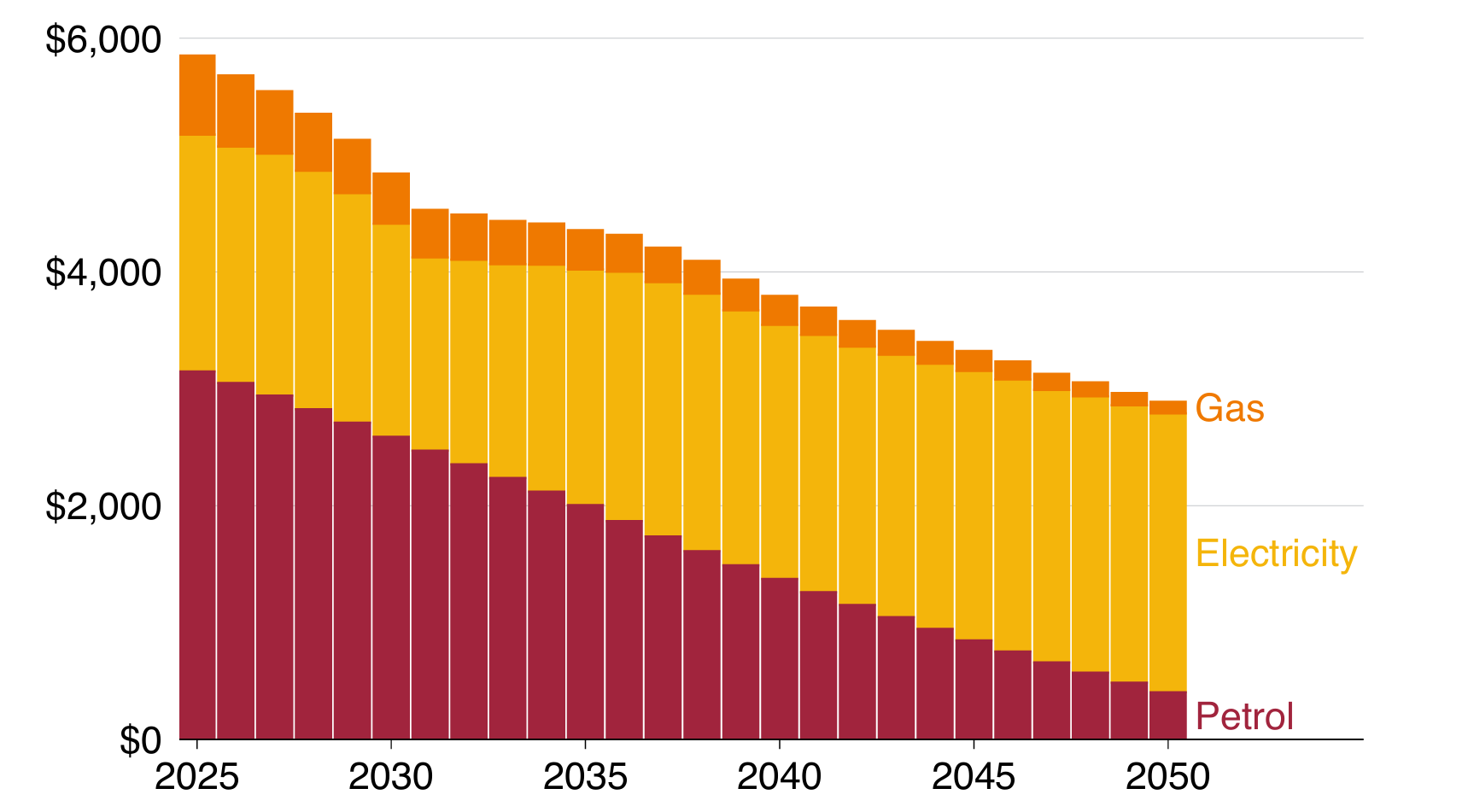
Household energy bills are set to
halve by 2050
Average annual household energy costs in the Grattan Institute’s ‘no new policy’ scenario, by fuel source.
News in brief
UN adopts landmark declaration on sea-level rise
In a move that’s critical to low-lying coastal and island nations the United Nations General Assembly has made its first declaration on rising seas. The declaration recognises sea level rise as a growing threat to communities, infrastructure, livelihoods and cultures. The agreement calls for stronger adaptation and resilience measures, improved data and early warning systems, and greater support for vulnerable countries. It also affirms that countries threatened by sea-level rise should retain their statehood and maritime rights under international law.
New tool reflects advances in climate attribution science
A new open-source tool estimates the climate impacts associated with emissions from individual coal, oil and gas projects. The Carbon Impacts Tracer has been developed by researchers, including from the University of New South Wales. It brings together relationships established in peer-reviewed climate research, using published evidence that links cumulative carbon dioxide emissions to warming and then warming to 8 specific impacts. Those impacts include dangerous heat exposure, crop losses, glacier melt and coral bleaching. The tool offers new ways to examine how emissions from individual projects contribute to cumulative global climate impacts.
Renewable energy pipeline could unlock $40 billion in investment
Australia has more than enough renewable energy and battery projects in development to meet the Australian Government’s 82% renewable electricity target by 2030, according to the inaugural Australian Renewable Energy Scorecard. However, too few projects are progressing to construction. Developed by the Institute for Energy Economics and Financial Analysis (IEEFA) and Green Energy Markets, the scorecard identifies a lack of long-term power purchase agreements (PPAs) as a key barrier to construction. It estimates that moving fully approved projects into construction could unlock more than $40 billion in investment and generate 127,000 job-years of construction work. The scorecard will be updated quarterly to track progress across Australia.
Planning renewables around industry, nature and farming
New Climateworks Centre analysis finds integrated land use planning could help meet the growing electricity needs of heavy industry while managing impacts on biodiversity and agriculture. Modelling for Queensland for example, finds high value biodiversity areas could be protected for around 1% more in system costs, while less than 0.2% of agricultural production would be affected. The analysis highlights the value of coordinating industrial demand, renewable generation and transmission. These connections also feature in the sector-by-sector analysis and modelling that informed the Authority’s 2035 Targets Advice.
Pre COP31 electrification pledge to drive diverse and sustainable energy sources
The COP31 Presidency has released its 35-by-35 Global Electrification Pledge, setting an ambitious global goal for electricity to account for 35% of final energy consumption by 2035. The pledge acknowledges that increasing electricity’s share of final energy consumption can translate into economy-wide emissions reductions. The Presidency committed to pursuing 35-by-35 in ways that limit warming to 1.5°C and compliment efforts to expand renewable energy and improve energy efficiency.
The Presidency also announced the Antalya Pledge on Artificial Intelligence, which will establish principles for the climate-responsible design, procurement, powering and deployment of AI. A draft is expected ahead of COP31.
Australia sets a national course for the ocean
Australia’s first Sustainable Ocean Plan sets a shared national vision for managing the ocean and supporting Australia’s $229 billion ocean economy. The plan identifies 8 priorities, including climate action, ocean industries, marine resilience, First Nations participation and finance. It also recognises the ocean’s role in regulating the climate and supporting renewable energy. The plan was informed by engagement with more than 800 people and organisations over 2 years. Early implementation steps will involve the Australian Government establish a National Ocean Steering Committee and a National Ocean Advisory Group to pursue outcomes across the priority areas.
Low sea ice persists at both poles
Antarctic sea ice recorded its third-lowest winter peak since satellite records began 48 years ago, according to provisional data reported in Carbon Brief. Scientists say more observations are needed to determine whether recent Antarctic conditions signal a long-term shift. In the Arctic, sea ice reached its annual minimum on 12 September, tying as the 10th lowest on record. Researchers have identified a clear long-term decline in Arctic sea ice, while long-term trends in Antarctic sea ice remain less certain.
Regulator find sustainability reporting is improving under new rules
Climate-related reporting is improving under Australia’s new sustainability disclosure requirements according to the Australian Securities and Investments Commission (ASIC). In a statement ASIC reported the quality, quantity, and consistency of disclosures have improved based on sustainability reports lodged for the 2025 financial year. ASIC found the new reporting requirements had increased transparency and organisations were engaging more meaningfully with climate-related risks and opportunities. The regulator also identified areas for improvement including aspects of strategy, metrics and targets disclosures.
Maritime decarbonisation could reshape Australia’s trade
A new Global Maritime Forum insight brief examines the impacts maritime decarbonisation could have on Australia’s exports, economy and security. Australia’s key trading relationships with Japan, South Korea and China are expected to be among the impacts as they move to reduce emissions across global supply chains. Competitiveness will increasingly be influenced by the emissions performance of the products Australia exports and the systems used to transport them. The brief also explores how Australia could respond as shipping adopts lower-emission fuels and technologies.
Our feature this week

‘Urgent’ energy transition to have profound implications for our economy and society
The Treasury’s latest Intergenerational Report has found there are 5 major transitions impacting Australia’s economy and society. Of them, the energy transition is becoming ‘more important and urgent’ and offers unique opportunities for households and industries.
Energy and the other transitions – the artificial intelligence (AI) revolution, geopolitical fragmentation, an aging population and the care economy – will be defining influences over the next 40 years.
The report found individuals and households are helping to speed up the energy buildout as they seek energy bill savings from electrification. Australia is already leading the world on consumer energy resources. Over 36% of suitable dwellings in the National Electricity Market (NEM) have rooftop solar and over half a million households have a battery.
Treasury modelling found clear gains for a household that installs solar and a battery, and that swaps its gas appliances and petrol cars for electric ones, with estimates it could save about $4,300 per year.
For Australia’s industries, the report argues that continued disruption in global energy supply chains will reveal the benefits from reliable renewable energy and electrification. In addition, opportunities for Australia’s industries are expected to expand as global demand shifts towards low-emissions products and reforms to gas markets and liquid fuel reserves boost Australia’s energy resilience.
Treasury projects green exports such as green metals, green ammonia and critical minerals could exceed $100 billion a year by 2050. A stronger renewable exports pathway could add $68 billion above that baseline.
Treasury also projects the value of green exports to exceed the value of fossil fuel exports in the early 2030s. If Australia seizes its opportunities, green exports could be worth much more in 2050 than fossil fuel exports are worth today. Coal and liquefied natural gas exports earned about $127 billion in 2025–26, with prices elevated due to conflict in the Middle East.
The report also highlights risks for Australia, including the risks of a disorderly energy transition. Many coal-fired power stations are more than 40 years old and are becoming less reliable. Under Treasury’s disorderly transition scenario, greater reliance on coal and gas lifts average wholesale electricity prices by 17% during the 2030s. Prices could be a further 13 percentage points higher if there are outages at the two oldest coal-fired generators.
Faster investment in renewables and storage is needed to enable timely retirement of coal-fired generators and to meet growing electricity demand. The report cites the Authority’s recommendation in its 2025 Annual Progress Report to accelerate environmental approvals for renewable energy and storage projects.
As a new focus area in this year’s report, AI also has consequences for the energy transition. Rapid growth in AI and cloud computing is driving investment in data centres, which are projected to consume about 10% of electricity in the NEM by 2050. The Australian Government is developing standards for large data centres to ensure that they invest in new renewable electricity supply.
The imperative for global action on climate change is evident in the report, as climate damage will place increasing pressure on households and government budgets. More frequent and severe disasters will damage infrastructure, disrupt economic activity and increase insurance costs.
The report shows how major trends and the policy choices made now can create and harness opportunities for people, businesses and industries, as well as reduce costs and improve Australia’s resilience in the decades ahead.
What do you think of OGA?
Acknowledgement of Country
The Authority recognises the First Nations people of this land and their ongoing connection to culture and Country. We acknowledge First Nations people as the Traditional Owners, Custodians and Lore Keepers of the world's oldest living cultures, and pay our respects to their Elders—past and present.
Follow us on

Unsubscribe
Built with
