

On Good Authority
6 May 2026
Hi there,
Welcome to this fortnight’s edition of On Good Authority. In international news, we look at some of the changes in Asia’s energy mix as a result of the conflict in Iran and at a new coalition that will create sustainability standards for AI data centres.
Closer to home there’s news from WA as the government streamlines environmental approvals and new funding for renewable energy projects in First Nations communities through ARENA’s Regional Microgrid Program.
For further news and updates please follow us on Facebook, Instagram and LinkedIn.
Authority news
Our Chair, the Hon. Matt Kean has been talking about the financial and national security benefits of decarbonisation and more at the CEDA 4th Annual Climate & Energy Summit and the ARBS Conference, both in Melbourne. To read his latest speeches please visit the news section of our website.
Our 2026 Stakeholder pulse survey is now live and we invite your participation. We want to know what you think about your engagement experience, as part of our commitment to improving over time. The survey closes 11pm, 5 June 2026.

Fun fact
90%
is the amount a household that fully electrifies could reduce total energy costs by.
Source: Australian Energy Market Commission Residential Electricity Price Trends report

News in brief
Asia rethinks LNG, fast-tracks cleaner power
The Institute for Energy Economics and Financial Analysis finds that the Iran conflict is accelerating changes in Asia’s energy mix, as liquefied natural gas (LNG) faces growing concerns around price volatility and supply reliability. China’s imports of LNG in March fell by just over a fifth (21%) year-on-year and Vietnam has cancelled LNG projects. South Korea, India, the Philippines, Thailand and Cambodia are ramping up renewables to reduce reliance on imports. While short-term responses still lean on existing infrastructure, the shift is building momentum toward more secure, locally-sourced and sustainable energy systems across the region.
Atlantic Ocean currents face growing strain from climate change
Scientists caution that warming seas, melting ice and increased rainfall are weakening the Atlantic Meridional Overturning Circulation (the AMOC), raising concern about a long‑term slowdown and possible tipping points. The AMOC is a vast ocean system that helps distribute heat, regulate rainfall, and move nutrients and carbon worldwide. A collapse of this system could drive abrupt climate shifts, including cooling, rainfall changes, sea level rise, and impacts on food systems and ecosystems. A new Carbon Brief explainer outlines the science and ongoing debate about future risks.
Global coalition sets sustainability standards for AI data centres
Nine global building and climate organisations, including the Green Building Council of Australia, have established the Greening AI Data Centres Coalition to create an internationally-aligned sustainability framework for data centres that support artificial intelligence. The initiative will develop criteria for environmental and social performance, including energy and water use, and supports the development of credible green finance instruments. The coalition set up follows the recent release of expectations for data centres and AI infrastructure under the Australian Government’s National AI Plan.
Conference explores pathways to transition away from fossil fuels
Reducing economic dependence on fossil fuels, transforming supply and demand, and advancing international cooperation were key themes at the first Conference on Transitioning Away from Fossil Fuels held from 24–29 April 2026. Co-hosted by Colombia and the Netherlands, representatives from more than 50 national and sub national governments, international organisations and experts met to discuss practical approaches to overcoming structural dependencies and debt constraints, expanding reliable energy access, and supporting diversified, resilient economies. The next conference will be convened by Tuvalu and Ireland in 2027.
WA streamlines environmental approvals
Major mining, renewable energy and housing projects in Western Australia are set to benefit from faster environmental approvals under a new agreement between the Australian and WA governments. The Memorandum of Understanding (MoU) advances the Authority’s 2025 recommendation to streamline approvals through a single, nationally consistent process. It will reduce duplication between state and federal processes, paving the way for quicker, more streamlined decisions while maintaining strong environmental protections. The MoU is expected to introduce a single, state-led assessment process under new national standards, helping unlock investment across key sectors like energy and critical minerals. Negotiations are now underway, with a bilateral agreement targeted by the end of 2026.
First Nations solar microgrids win ARENA support
The Australian Renewable Energy Agency (ARENA) has committed $11 million to support two First Nations led microgrid projects in Borroloola and Ltyentye Apurte in the Northern Territory. The projects will use solar and battery systems to improve power reliability, reduce diesel use and support local ownership of energy infrastructure in remote communities. The funding is part of ARENA’s Regional Microgrid Program, which grants $125 million for microgrids in regional and remote areas, including $75 million dedicated to projects in First Nations communities.
Warming oceans drive mass shearwater deaths on Australian beaches
Researchers studying seabird deaths during the 2023–24 Australian summer marine heatwave report a sharp rise in short tailed and sable shearwaters washing up dead along southern and eastern beaches. The study finds the main cause was starvation, rather than strong winds or migration stress. During the heatwave, an estimated 629,000 adult shearwaters died, about 3% of the global short tailed shearwater population. The researchers found that warming waters reduced or displaced key prey species, leaving birds weakened and unable to survive. They also note that Australia’s east coast waters are warming faster than the global average, and that marine heatwaves are expected to become more frequent, intense and longer lasting, increasing the likelihood of similar events in the future.
Myth-information

Did you know that opening new offshore oil drilling won’t secure Australia’s fuel supply?
Australia’s known oil reserves are limited and in long-term decline. Domestic production can’t meet demand. Developing new reserves would be costly and slow, and still leave Australia dependent on volatile global oil markets. Real energy security comes from home grown renewable electricity and storage – and these technologies are already being rolled out at scale.
Charting the transition
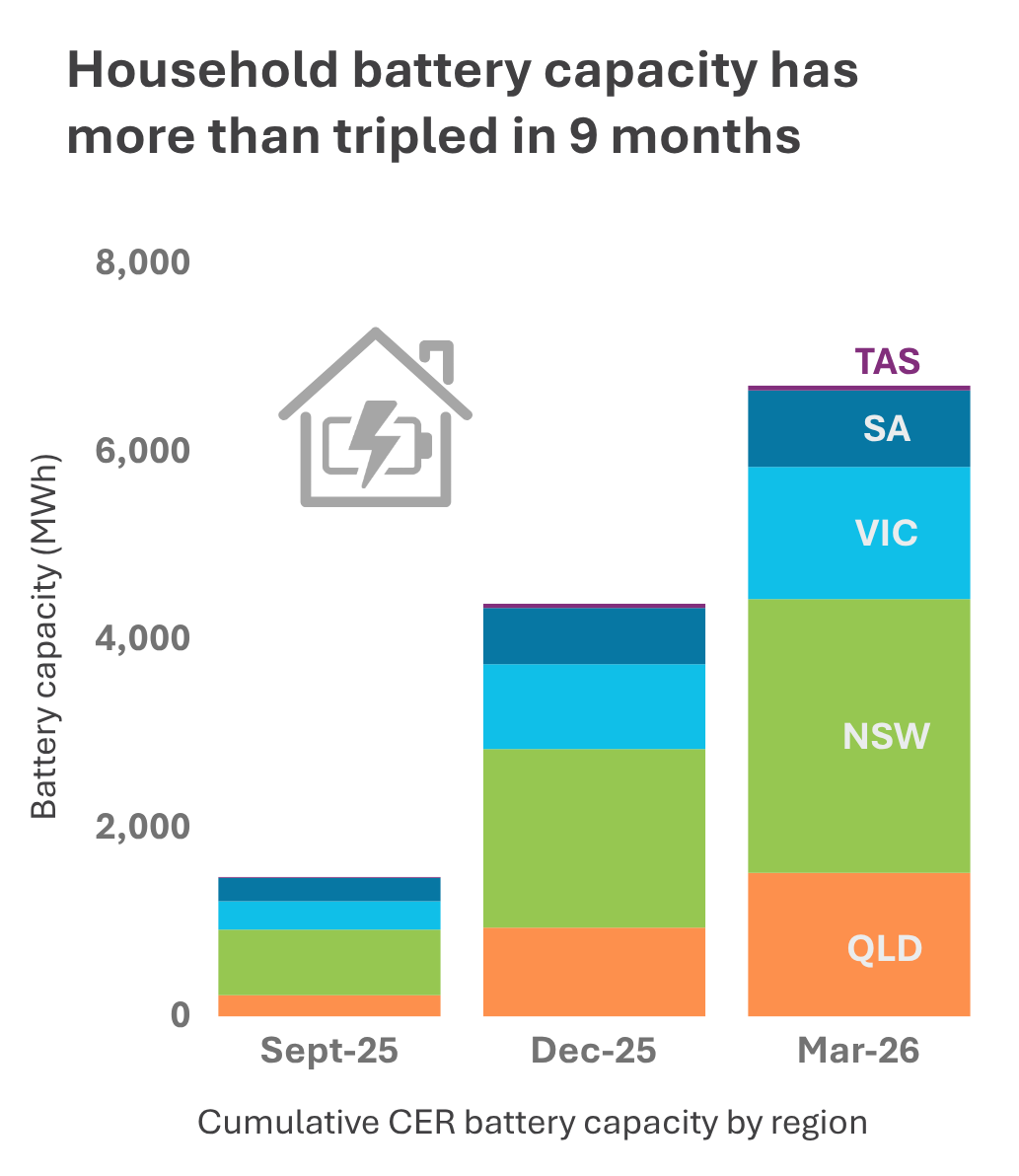
Household battery uptake has rapidly increased over the past 9 months bolstered by the Australian Government’s Cheaper Home Batteries Program.
Source: AEMO Quarterly Energy Dynamics Q1 2026 page 11
What do you think of OGA?
Acknowledgement of Country
The Authority recognises the First Nations people of this land and their ongoing connection to culture and country. We acknowledge First Nations people as the Traditional Owners, Custodians and Lore Keepers of the world's oldest living cultures, and pay our respects to their Elders—past and present.
Follow us on
Unsubscribe
Built with
