


On Good Authority
8 April 2026
Hi there,
Welcome to this fortnight's edition of On Good Authority. EV sales have hit an all-time high in Australia, while electric trucks recently beat expectations on cost and travel time in a delivery from Sydney to Canberra. Meanwhile, new Australian government guidance for data centres and AI infrastructure aims to promote renewable energy use. And India, which is one of our top 5 trading partners, has a new emissions reduction target.
For further news and updates please follow us on Facebook, Instagram and LinkedIn.
Authority news
Do you have ideas for how the Authority can monitor Australia’s progress towards a prosperous, resilient, net zero future? Work is underway to develop an Evidence Platform that will, over time, provide a balanced picture of Australia’s climate progress. Have your say through our 2026 Evidence Platform Issues Paper. Submissions close 30 April.
We’re hiring!
Applications for ongoing and non-ongoing roles in our Analysis Branch and our Systems and Science Branch will close on 12 April 2026:
Fun fact
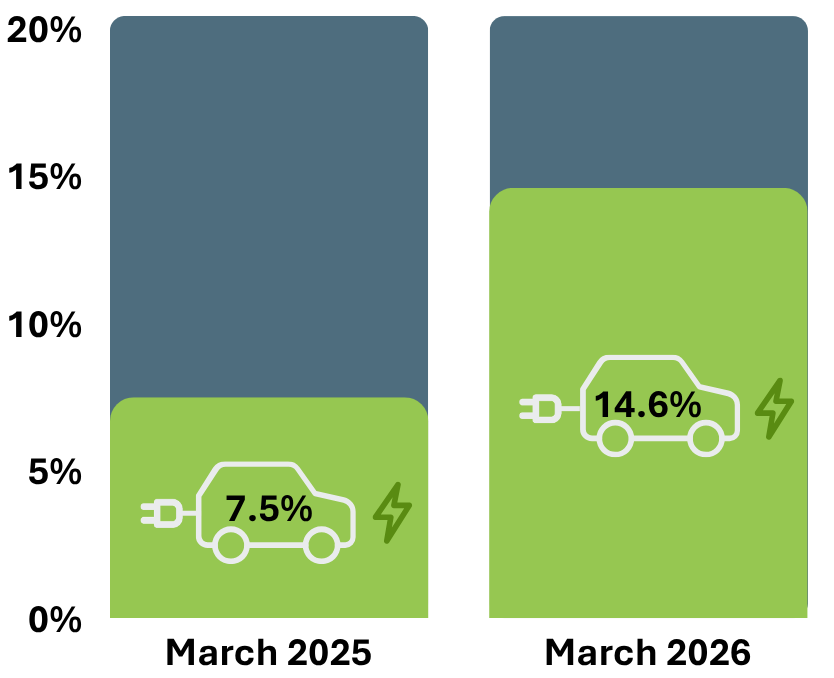
Battery electric vehicle sales reached a record high share of the Australian market in March. The share of sales almost doubled compared to the same period last year.
News in brief
Electric truck milestone demonstrates lower energy costs and faster travel times
A successful delivery has shown how electric trucks can operate efficiently and reliably across freight routes in Australia. New Energy Transport, working with logistics partner Australian National Couriers (ANC), recently completed Australia’s first fully electric end‑to‑end freight delivery from Sydney to Canberra. A Windrose electric prime mover transported goods from a Sydney distribution centre to Canberra, where ANC’s electric vans handled last‑mile delivery, on a single charge. The journey demonstrates the technical feasibility of intercity electric heavy vehicles over several hundred kilometres. New Energy Transport reported lower energy costs and comparable or faster travel times than diesel equivalents.
How to reshape Australia's data centre landscape
New expectations for data centres and AI infrastructure under the Australian Government’s National AI Plan aim to link faster approvals to projects that support clean energy, water stewardship, community outcomes and national interest. The move has sparked debate, with industry and analysts questioning whether fast‑tracking will do enough to address rising energy demand and social impacts. Data centre operators are also increasingly turning to renewable power purchase agreements to meet growing electricity needs driven by AI and cloud computing while supporting the energy transition.
Inquiry finds misinformation is having real world energy impacts
Persistent misinformation has undermined public confidence and distorted decision-making in Australia’s energy transition, according to a Senate inquiry. The Select Committee on Information Integrity on Climate Change and Energy concluded misleading narratives have delayed investment, stalled projects, inflamed community opposition to projects and weakened trust in institutions managing the energy system. The committee also called for coordinated whole-of-society actions across government, regulators, media, education systems and communities.
Funding deal supports Australia's second largest aluminium smelter
Rio Tinto and the Queensland and Commonwealth governments have struck a landmark AUD2 billion, 10 year partnership to secure the long-term future of the Boyne aluminium smelter at Gladstone. The agreement will keep the smelter operating beyond its current power contract in 2029 through to at least 2040, while supporting a transition to renewable energy. The agreement supports a long-term future for aluminium smelting in Queensland and builds on power purchase agreements signed by Rio Tinto to underwrite AUD7.5 billion in new renewable energy and storage in the state.
Improved near term gas supply
The risk of peak-day gas shortfalls have been pushed back to winter 2029, according to the Australian Energy Market Operator’s 2026 Gas Statement of Opportunities.The improved gas supply across eastern Australia is driven by:
higher peak day supply
new infrastructure coming online
reduced consumption forecasts.
Total gas consumption is forecast to decline as households, businesses and industry electrify, and as more batteries connect to the grid. Compared to last year’s statement, the projected timing of supply pressures has shifted back by a year.
India lifts climate ambition with new NDC
India has announced an updated 2035 climate commitment, strengthening its emissions reduction targets, known as a nationally determined contribution (NDC), under the Paris Agreement. The new 2035 targets include:
47% reduction in emissions intensity of GDP from 2005 levels
60% installed electricity capacity from non‑fossil sources
expanded forest and tree cover capable of absorbing up to 4 billion tonnes of CO₂.
The commitment also puts more focus on climate adaptation across agriculture, water and health, alongside promoting sustainable lifestyles. Together, these measures set out how India plans to balance near‑term action with its longer‑term goal of net zero emissions by 2070.
Reports finds Earth's climate under unprecedented strain
Earth’s climate system is increasingly out of balance, finds the World Meteorological Organisation’s State of the Global Climate 2025. The report confirms 2015–2025 are the hottest 11 years on record, with 2025 at about 1.43 °C above the 1850–1900 average. More than 90% of excess heat from greenhouse gases is stored in the ocean, which reached record heat levels in 2025, accelerating sea‑level rise and stressing marine ecosystems. These findings align with the Authority’s 2035 Targets Advice, which estimates the remaining global carbon budget at roughly 6 years at current emission rates.
Australian super funds evolve practices amid net zero transition
Australian superannuation funds are increasingly using corporate climate transition plans to guide investment and stewardship decisions, according to a new Climateworks Centre briefing paper. Climate transition plans provide valuable company data, and superannuation firms are using this data to differentiate companies based on current and future exposure to climate risks. Funds use the plans to assess risk, compare companies within sectors, and inform engagement and voting. This enables funds to more accurately assess the future climate risk exposure of their portfolios, which can then impact how funds are stewarded and how members vote.
APRA stress test highlights risk of growing uninsured losses
A stress test by the Australian Prudential Regulation Authority (APRA) has looked at how home insurance coverage could change between now and 2050 under different climate scenarios. The testing considered 2 possible futures: one with higher emissions and more severe weather events, and another with lower emissions but economic disruption from a delayed but fast transition to a low carbon economy. Under both scenarios, the testing found more freestanding homes would be uninsured by 2050 than today. The gap between insured and uninsured homes is even wider in regional and rural areas.
What do you think of OGA?
Acknowledgement of Country
The Authority recognises the First Nations people of this land and their ongoing connection to culture and country. We acknowledge First Nations people as the Traditional Owners, Custodians and Lore Keepers of the world's oldest living cultures, and pay our respects to their Elders—past and present.
Follow us on

Unsubscribe
Built with
