


On Good Authority
11 March 2026
Hi there
Welcome to this week’s edition of On Good Authority. This fortnight, we highlight how renewables are strengthening Australia’s energy security amid geopolitical tensions, and the US’ move to plug-in solar. We have some good news about Australia’s continued fall in emissions and how protected cropping is helping safeguard Australia’s food production. New analysis also shows gas prices—not renewables—are the main driver of rising power bills, and we look at a new First Nations guide on equity in clean energy projects.
For further news and updates please follow us on Facebook, Instagram and LinkedIn.
Authority news
Our members have been talking about the energy transition, climate science and more over the past fortnight:
3 March – Chair Matt Kean gave a keynote speech at the Suits to Wilmot event near Armidale. In his speech Matt noted the benefits that decarbonisation can deliver to regional Australia and the agriculture sector.
9 March – Chair Matt Kean was among speakers at the opening day for Climate Action Week Sydney, which includes a series of community-led events designed to elevate NSW's contribution to global climate action.
25 February – Chair Matt Kean spoke at the Nature Conservation Council NSW Business Breakfast, emphasising the urgency of climate action and the role of clean technologies and clear targets in driving Australia’s transition.
More speeches and opinion pieces can be read on our website.
News in brief
Defending harvests in extreme weather
Protected cropping is becoming an important tool for adapting to worsening heat, floods and other climate extremes it has been reported. Systems range from low-tech solutions like netting through to advanced automated glasshouses. Only about 17% of Australia’s food production currently protected cropping systems, mostly in low-tech setups. Countries like the Netherlands have scaled protected cropping, helping them to become one of the largest food exporters in the world.
Emissions continue to fall
Australia’s annual greenhouse gas emissions dropped in September 2025. Overall emissions fell by 1.9% (8.5 Mt CO₂-e). The emissions intensity of the economy (emissions per GDP unit) also continued a downward trend, dropping 56.2% since annual June 2005 levels. The biggest falls were in fugitive emissions (down 3.8%; 1.8 Mt CO₂-e) and electricity emissions (down 3.1%; 4.8 Mt CO₂-e). There were also small, but notable, drops in transport (down 0.4%; 0.4 Mt CO₂-e) for the first time since the COVID-19 pandemic, and agriculture (0.1%; 0.1 Mt CO₂-e). An uptick in metals production contributed to a 2.1% (0.6 Mt CO₂e) rise in industrial processes and product use emissions.
Gas-fired bill shock: report finds renewables are not the problem
New analysis has found gas prices and failing coal-fired power stations are behind higher power bills. The Climate Council’s report found gas prices have surged since Australia started exporting fossil gas from the east coast in 2015. Volatile global markets and dependence on unreliable coal generators has since contributed to electricity price spikes. The best way to keep driving down wholesale prices is to boost the share of renewables and storage in Australia’s main grid.
Renewables and electrification strengthen resilience amid global tensions
The recent strikes on Iran highlight how easily geopolitical shocks can disrupt global oil flows, underscoring the vulnerability of oil dependent economies. But countries ramping up renewables and electrifying transport are showing that reducing oil dependence can strengthen energy security and buffer economies from these kinds of shocks.Cuba has dramatically boosted solar power generation from 5.8% to more than 20% in 12 months to early 2026, while Ethiopia has banned new internal combustion vehicles. Ukraine is expanding distributed solar and wind generation to make its energy infrastructure more resilient to attacks, and China continues to rapidly grow its electric vehicle fleet to lower imported oil dependence. These shifts show how local renewable generation and electrification can support ongoing access to energy and mobility with flexibility and stability amid geopolitical unrest.
Empowering First Nations equity in clean energy projects
A new guide to help First Nations communities assess opportunities to take part in clean energy projects is now available. Released by the First Nations Clean Energy Network, the guide outlines what equity involvement means, the potential risks and benefits, and options for involvement. Around 43% of the clean energy infrastructure needed to reach net zero emissions by 2060 will be in areas where First Nations groups have legally recognised rights, interests and aspirations.
US considers plug-in solar to help more households save
The World Resources Institute reports that rising electricity prices have prompted US states to explore plug-in solar – a small, affordable, apartment-friendly technology that can cut household energy costs without requiring rooftop installation or utility interconnection. At least 24 states are looking at removing legal barriers so more households, especially renters, can benefit. In Europe, Germany has more than a million homes already using plug-in systems to lower bills and expand access to clean energy. The report urges governments to modernise outdated rules so everyday households can easily use small solar devices and start saving—making clean, affordable energy accessible to more people.
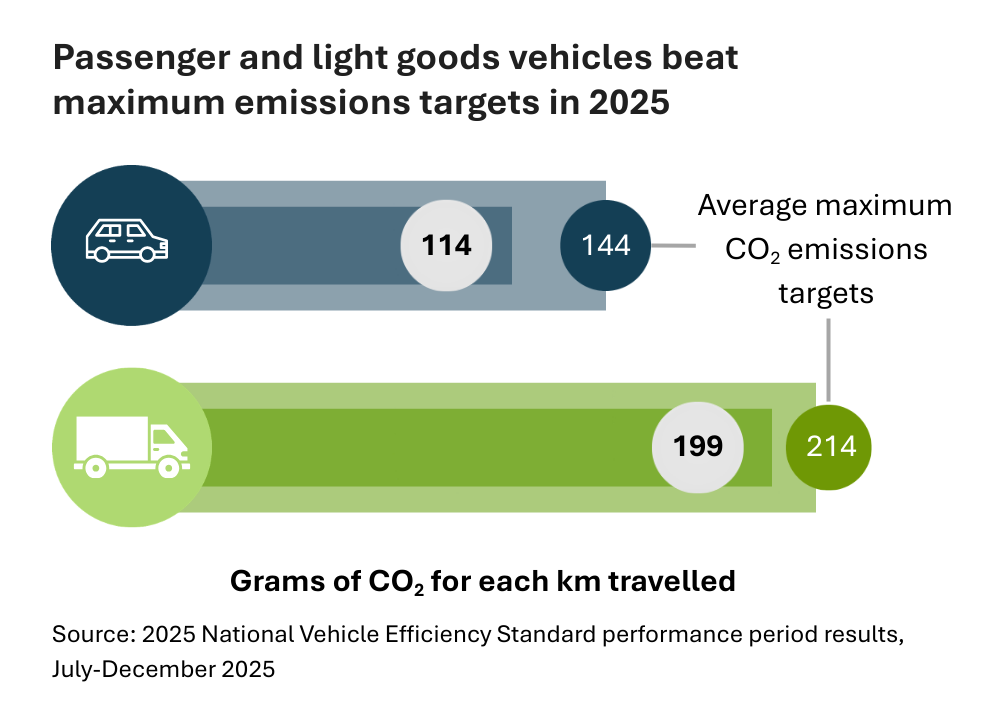
NVES early results highlight role in emerging decline in transport emissions
Australia’s New Vehicle Efficiency Standard has already generated roughly 16 million tradeable credits from almost 621,000 new vehicles. Since the scheme began in July 2025, BYD, Tesla, and Toyota are banking large credit surpluses, while Mazda, Nissan, and Subaru face growing deficits. Early results show almost 70% of brands met targets, cutting an estimated 190,000 – 220,000 tonnes of CO₂-e – equivalent to removing 100,000 older cars from roads. Tougher limits from 2026 will push more hybrids and electric vehicles sales, linking directly to emissions reductions like those illustrated below.
These early trends reinforce the Authority’s targets advice by showing how strong, predictable vehicle efficiency standards can lock in sustained emissions cuts across the transport sector.
China’s carbon intensity goal sends mixed signals about climate ambition
China will continue to develop its clean energy industries, as outlined in its just-released draft 15th five-year plan. This five-year plan sets the strategic direction for China until 2030. Reaffirming support for solar energy, hydrogen, new energy storage and electric vehicles, the plan also aims to cut CO₂ emissions per unit of GDP carbon intensity by 17%. Of particular note is China mentioning its willingness to steer climate governance and be a provider of global public goods, in the form of clean energy technologies. China noted this is the period when they will achieve ‘carbon peaking’ of emissions in their economy. In the last five-year plan, covering 2021-2025, China achieved a carbon-intensity reduction of 17.7%, just short of its 18% goal. Commentators questioned the new, lower reduction calculation for this period, noting a change in the way carbon intensity was measured. The new methodology allows for China’s emissions to rise by 3-6% over the next five years and still achieve their target. The new plan also doesn’t set an absolute cap on emissions or a timeline for phasing out coal and gas use.
What do you think of OGA?
Acknowledgement of Country
The Authority recognises the First Nations people of this land and their ongoing connection to culture and country. We acknowledge First Nations people as the Traditional Owners, Custodians and Lore Keepers of the world's oldest living cultures, and pay our respects to their Elders—past and present.
Follow us on

Unsubscribe
Built with
